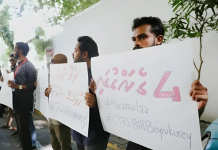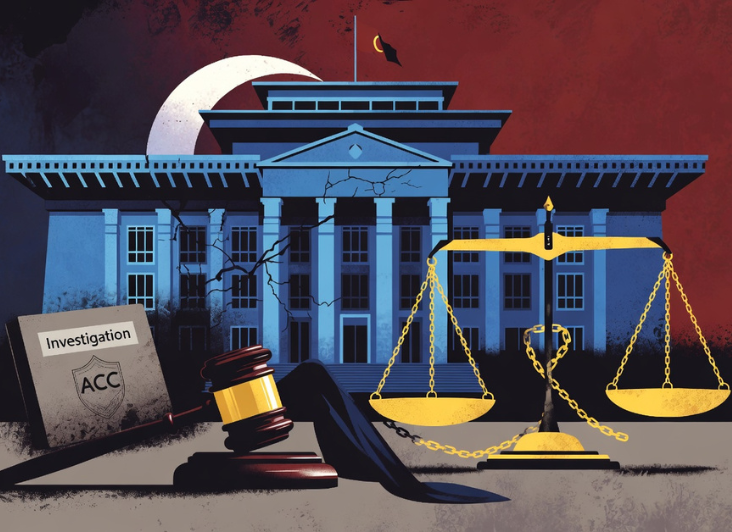
More than a year after the Anti-Corruption Commission (ACC) announced it was investigating criminal allegations involving several Supreme Court justices, reports indicate that the commission has yet to even question the individuals implicated in the case.
The Anti-Corruption Commission (ACC) launched an investigation in February 2025 into cases involving then-Supreme Court Justices Husnu Al Suood, Mahaz Ali Zahir, and Dr. Azmiralda Zahir. Reports show that the ACC has still not questioned the individuals involved. Despite repeated efforts by the judges and their lawyers to seek updates, the commission has provided no information on the current status of the case.
Here is a clear timeline of events:
- November 2024: Parliament fast-tracked the anti-defection law, allowing political parties to remove MPs and vacate their seats if they change sides or are expelled. Many viewed it as a move to strengthen the ruling party’s control.
- February 26, 2025: As the Supreme Court was about to hear a constitutional challenge to the new law, the Judicial Service Commission (JSC) suspended the three justices — Dr. Azmiralda Zahir, Mahaz Ali Zahir, and Husnu Al Suood — citing a letter from the ACC regarding a criminal investigation. The letter provided no clear details or evidence.
- March 2025: Justice Husnu Al Suood resigned, accusing President Muizzu, the Attorney General, the JSC head, and the ACC head of attempting to control the Supreme Court. The JSC then moved quickly against Dr. Azmiralda Zahir and Mahaz Ali Zahir. The hearings were expedited and reportedly gave the judges limited opportunity to present witnesses or mount a full defense.
- May 2025: The JSC recommended the removal of the two justices. Parliament voted 68-11 to dismiss Dr. Azmiralda Zahir and Mahaz Ali Zahir.
- Late 2025: The ACC requested the judges’ statements from the JSC — only six months after the judges had already been removed.
- February 2026 (one year later): The constitutional case remained stalled. The ACC described the investigation as a “special priority” but provided no updates and filed no charges.
- April 2026 (more than 14 months later): Lawyer for Dr. Azmiralda Zahir, Ibrahim Shameel, stated that the ACC has shared no information and shown no progress. The judges have not been questioned. Meanwhile, the Supreme Court — now with a changed composition — is set to deliver its verdict on the anti-defection law this Wednesday.
This appears to be more than a simple delay in one case. The ACC’s brief letter was sufficient to suspend the justices immediately. Yet after 14 months, there has been complete silence: no charges, no public report, and no questioning of the judges. If the allegations were serious enough to justify removing two Supreme Court justices, the investigation should have proceeded with urgency. Instead, it has remained dormant long after the judges lost their positions.
The ACC requested statements only after the dismissals had taken place. This slow pace raises serious doubts about the true motive behind the suspensions. The timing coincided precisely with the Supreme Court’s impending review of the anti-defection law — a law that grants additional power to the ruling party in Parliament. With one justice resigned and two removed, the court’s composition changed significantly.
The ACC maintains that it handles every case fairly and that no one is above the law. However, its prolonged silence on this high-profile matter tells a different story. When the country’s primary anti-corruption body remains quiet for over a year on such a critical issue, public trust in the justice system is inevitably weakened.
The Supreme Court is scheduled to deliver its verdict on the anti-defection law this Wednesday (April 29, 2026, at 10:15 am) from a bench that was altered during these events. Whatever the outcome, the process used to remove the judges has already damaged public confidence in the judiciary.
Maldives needs strong and independent courts to protect the Constitution. Using a vague investigation to suspend and remove judges sets a dangerous precedent. It suggests that any judge who dares to check government power may not be secure. More than a year later, the central question remains unanswered: Who really dismantled the Supreme Court — and why has the ACC’s “investigation” vanished into thin air?