In the Maldives, Islam has long been a source of unity, moral guidance, and shared identity. It shaped society long before political parties and power struggles existed. Faith was meant to promote justice and accountability, not to shield leaders from criticism. Yet today, religion is increasingly used in politics not to uphold its values, but to protect those in power from public scrutiny.
This is not governance guided by faith. It is the strategic use of religion as a political shield. Under President Mohamed Muizzu’s administration, religious language is repeatedly used to silence critics, weaken democratic debate, and defend authority. When faith is politicized in this way, questioning government decisions begins to feel like questioning religion itself a dangerous shift for both democracy and Islam.
This approach did not begin after the election. During the 2023 presidential campaign, religious and nationalist narratives were actively used to influence voters. People were warned that national sovereignty was under threat. Religion, identity, and security were blended into an emotional message designed to create fear rather than informed debate.
Political opponents were not simply criticized for differing views. They were portrayed as threats to Islam or agents of moral decay. Complex national challenges were reduced to slogans. Facts were sidelined, fear replaced policy, and suspicion became a campaign strategy.
Once in office, this approach continued.
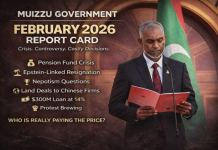
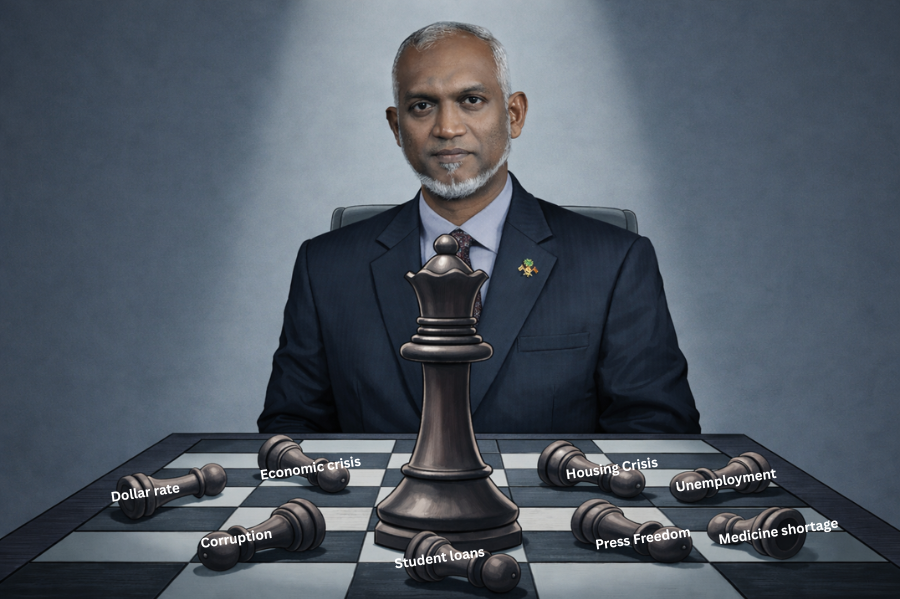
As the economy weakened, credit ratings were downgraded, students overseas were left without support, and major promises quietly collapsed. Instead of responding with transparency or reform, the government returned to religious messaging at convenient moments. Critics were framed as anti-Islamic. Journalists and media outlets faced pressure through a media control bill. Speaking out became risky, not because criticism was false, but because it could be labeled un-Islamic. This is not accidental. It is a deliberate political tactic.
When religion is used as a political weapon, accountability begins to look like blasphemy and criticism feels like betrayal.
What makes this more troubling is the selective use of religion. The government is loud when it comes to slogans and restrictive rules, often targeting specific groups or distracting from governance failures. At the same time, it remains silent on Islamic principles that truly matter — honesty, justice, trust, fairness, and accountability.
Islam clearly condemns corruption, nepotism, dishonesty, and abuse of public trust. These are not minor issues in the faith. Yet they are precisely the issues the government avoids confronting. Instead, attention is redirected toward symbolic controls.
Recently, the government introduced controversial regulations that sparked widespread criticism. A new education policy requires girls from Grade 4 onward to wear trousers, with strict conditions on skirts and shirts. At the same time, boys in Grade 9 and above are permitted to keep beards, provided they are neatly trimmed.
This pattern extends beyond schools. The Civil Service Commission has imposed strict dress code rules on female employees, regulating clothing length, fabric, sleeves, and even hair coloring. Tourists on local islands are now also subject to tighter dress guidelines. This is the first time such wide-ranging dress regulations have been imposed across education, government offices, and tourism.
In these cases, religion is not being used to guide leaders or correct abuses of power. It is being used to control people.
President Muizzu has also publicly described his political opponents as spreading anti-Islamic ideas. This rhetoric deepens social divisions and weaponizes faith against democratic dissent. The result is an “us versus them” politics, where political loyalty becomes a test of faith. In a small and fragile democracy like the Maldives, this weakens national unity and undermines democratic values.
Even religious institutions are affected. Scholars are praised when they align with power and sidelined when they question authority. Over time, this politicization erodes trust not only in institutions, but in religion itself.
History shows this pattern clearly. When leaders centralize power, weaken checks and balances, and fail to deliver results, they often turn to religion not out of devotion, but because faith remains one of the most powerful tools for controlling public opinion.