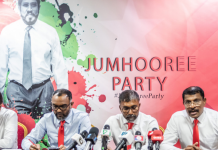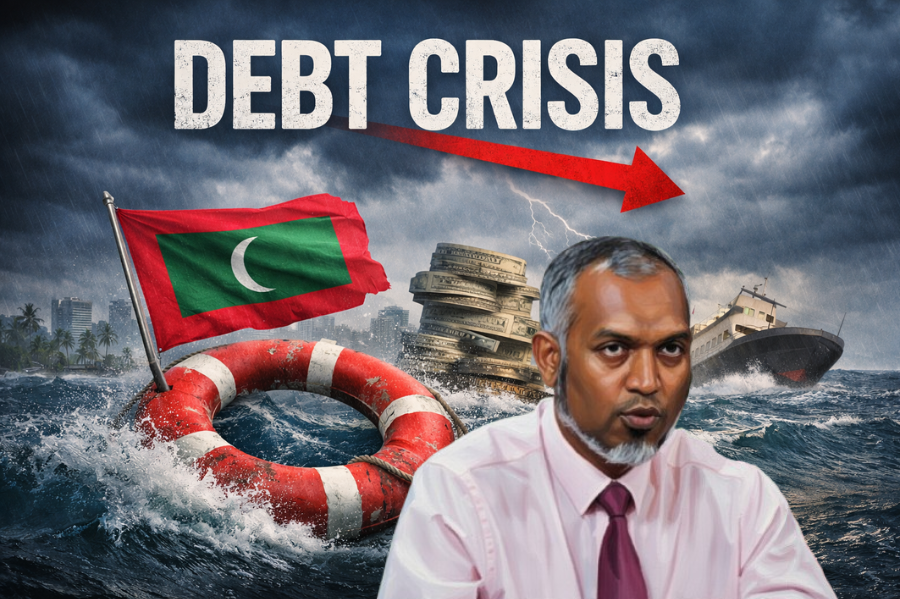
The Maldives is edging toward a dangerous debt crisis, not because of an unavoidable global shock, but due to poor planning, misplaced political priorities, and a serious lack of transparency under President Mohamed Muizzu’s government. As pointed out by the Fayyaz Ismail former chairperson of the Maldivian Democratic Party (MDP), the current administration inherited a recovering economy, rising state revenues, and strong tourism growth conditions under which public debt should have been reduced, not expanded.
Instead, the Muizzu government is pushing the country toward economic uncertainty while remaining silent on how it plans to manage growing debt obligations, including a looming USD 500 million sovereign Sukuk. The timing of the current borrowing spree is particularly troubling. Unlike during the COVID-19 pandemic, there is no external crisis today that justifies excessive borrowing. Tourism is booming, government income is increasing, and the economic recovery was already underway when this administration took office. Yet debt continues to rise, raising serious questions about fiscal discipline.
According to the former MDP chairperson, this borrowing is not strategic or growth-oriented. It is driven by political convenience rather than long-term economic planning. This contrasts sharply with how debt was managed during the pandemic. COVID-19 triggered one of the worst economic shocks in Maldivian history, with tourism collapsing overnight and more than MVR 25 billion in state revenue lost. With an economy heavily dependent on tourism, borrowing at the time was unavoidable.
Crucially, that borrowing was accompanied by clear fiscal consolidation measures and recovery plans. The MDP government ensured that state salaries were paid, welfare systems remained functional, and the economy continued to operate. Support was extended to furloughed private sector workers, the self-employed, and small and medium enterprises to prevent widespread collapse. Despite extraordinary global conditions, the Maldivian economy survived one of the worst crises in modern history.
Under the Muizzu government, however, debt is increasingly being used to finance political priorities rather than productive investment. Spending on military equipment, including drones, and the rapid expansion of political appointees has taken precedence over projects that directly support livelihoods and local economies. Despite significant public spending, many islands have seen little tangible benefit. Essential services remain stagnant, development projects are limited, and economic opportunities at the island level have failed to materialize.
One of the most damaging consequences of this approach is the weakening of the SME sector, the backbone of the Maldivian economy. Businesses that survived the pandemic are now struggling due to policy neglect, limited access to finance, and growing uncertainty. The former MDP chairperson warns that the damage being done today will have long-term consequences for employment, innovation, and economic resilience.
Adding to these concerns is the USD 500 million sovereign Sukuk set to mature in less than three months. Any responsible government should have planned for this well in advance. Refinancing sovereign debt is a standard global practice used to manage large repayments and protect foreign reserves. In 2021, the MDP government successfully refinanced a USD bond through the Maldives’ first international Islamic Sukuk, stabilising the economy and maintaining investor confidence during a period of global uncertainty.
After more than two years in office, the Muizzu government has failed to present any credible plan for this obligation. There has been no transparency, no reassurance to markets, and no clear communication with the public. This silence has fuelled fears of last-minute measures, rushed private borrowing at opaque and potentially high interest rates, or the depletion of foreign reserves and the Sovereign Development Fund simply to survive the repayment.
As the former MDP chairperson makes clear, the Maldives’ current debt problem is not the result of unavoidable circumstances, but of poor choices and failed leadership.