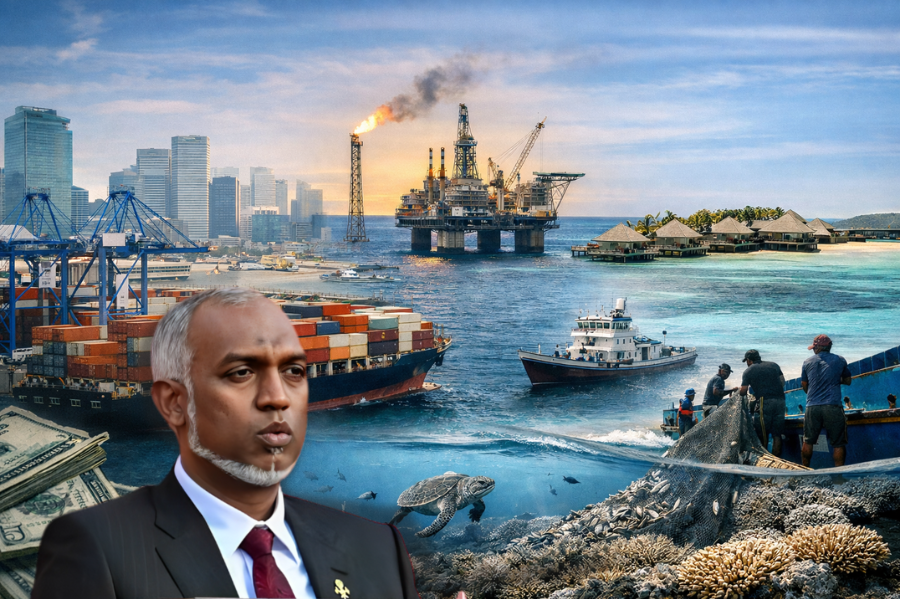
President Muizzu’s latest Special Economic Zones (SEZ) decree is being promoted as a bold economic development plan. In reality, it risks handing over the Maldives’ oceans, ports, and strategic industries to foreign investors, while leaving ordinary Maldivians behind.
Under Presidential Decree No. 1/2026, the minimum investment for strategic SEZ projects is USD 100 million, while “sustainable township” developments require USD 500 million. These staggering thresholds make it clear: this policy is designed for foreign mega-investors, not local entrepreneurs.
Who Really Benefits from Muizzu’s SEZ Policy?
No local business or Maldivian consortium can realistically meet these thresholds. SEZs have effectively become “elite-only zones,” accessible solely to multinational corporations and foreign state-backed investors.
Meanwhile, ordinary Maldivians face rising taxes, reduced subsidies, and limited opportunities. For a small island nation struggling with debt, foreign currency shortages, and a downgraded credit rating, surrendering control of strategic sectors is not development it is economic exclusion.
How SEZs Threaten Sovereignty and Strategic Assets
The decree opens the door for foreign investments in:
- Ports and harbours
- Transshipment hubs
- Airports and aviation services
- Logistics and warehousing
- International financial centres
- Energy projects
- Oil, gas, and mineral exploration
These are strategic national assets that affect sovereignty, national security, and foreign policy leverage. SEZs operate under special regulatory regimes, weakening government oversight while empowering investors. For the Maldives, this is both an economic and geopolitical risk.
Environmental Disaster in the Making
Allowing oil, gas, and mineral exploration contradicts the Maldives’ global image as a frontline climate-vulnerable nation.
Former Environment Minister Shauna Aminath warned:
“Allowing deep-sea mining and oil exploration is a grave mistake. It threatens marine biodiversity, destroys fishing grounds, and undermines tourism. Profoundly short-sighted.”
She added: “Depleting marine life is not economic diversification for a country that depends on ocean health.”
Public concern reflects these warnings: under the polished branding of SEZs, large areas of the ocean are being sold off, risking pollution, destruction, and lost livelihoods. The message is clear: destroying the ocean is not development. Fisheries, tourism, and marine ecosystems the backbone of the Maldivian economy are at stake.
Tax Breaks for Foreign Investors vs. Burdens for Citizens
While Maldivians are told to tighten their belts, SEZ investors receive extraordinary incentives:
- Long-term corporate tax holidays
- Duty-free imports
- Exemptions from GST, withholding tax, and customs duties
- Preferential land leases at below-market rates
This creates two parallel economies: a tax-free enclave for billion-dollar investors, and a debt-burdened reality for citizens. Fishermen pay fees, SMEs struggle under bank interest and import duties, while foreign investors contribute little to the national treasury. This is institutionalized inequality, not reform.
Empty Promises, Real Consequences
The decree details investment thresholds but offers no guarantee of local employment, skills transfer, revenue sharing, or accountability. The USD 500 million township projects are likely to remain on paper, locking away vast tracts of land for speculation while communities continue struggling with housing and livelihoods.
Selling the Country, Not Developing It
Muizzu’s SEZ policy follows a familiar pattern: grand announcements, nationalist rhetoric, and little concern for long-term consequences.
Without transparency, accountability, or a clear development roadmap, the policy risks creating the illusion of progress rather than delivering it. Looking at the government’s track record, skepticism is justified. Major projects have either failed, stalled, or remained unfulfilled, including:
- USD 8.8 billion financial centre in Hulhumalé
- Thinadhoo and Kadhdhoo international airport projects
- Rasmale’ project
- Development Bank of Maldives
- Bunkering services
Is President Muizzu genuinely pursuing sustainable growth through SEZs, or is the Maldives’ future being sold off under the guise of development? With oceans, strategic assets, and national sovereignty on the line, can ordinary citizens trust this policy to benefit them or is it just another false projection?