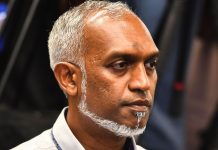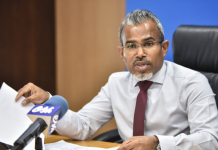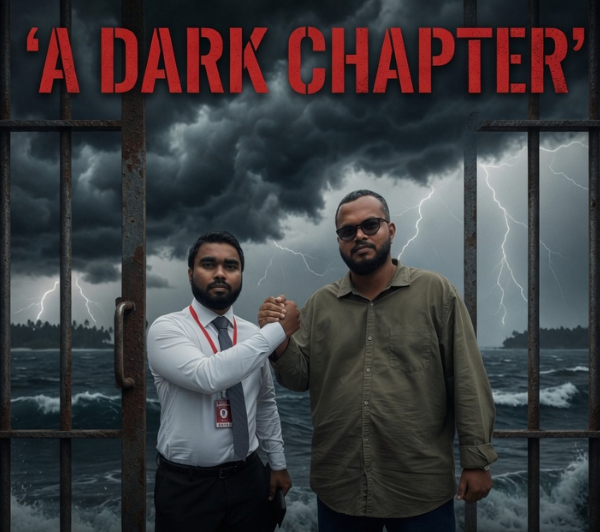
Under President Muizzu, press freedom the lifeblood of any genuine democracy is being systematically strangled. The recent jailing of two journalists from Adhadhu, Mohamed Shahzan and Leevan Ali Nasir, marks not just an attack on one newsroom, but a dangerous new low in the government’s escalating war on independent media.
On May 12, 2026, the Criminal Court sentenced Shahzan to 15 days in prison and Leevan to 10 days for “contempt of court.” Their alleged crime? Doing what journalists are supposed to do: asking questions and reporting the news. Shahzan was expelled from a presidential press conference after daring to question President Muizzu about serious allegations raised in Adhadhu’s investigative documentary Aisha. Leevan was punished for reporting on a court order. In a functioning democracy, these acts are not crimes they are obligations.
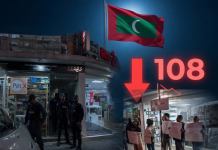
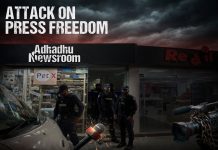
This incident did not occur in isolation. It follows a police raid on Adhadhu’s newsroom in late April 2026, where officers seized laptops, hard drives, and reporting equipment. Travel bans were slapped on senior staff, including the CEO and Managing Editor. Closed-door hearings and gag orders have been weaponised to shield power from scrutiny. International press freedom organisations, including the Committee to Protect Journalists (CPJ) and the International Press Institute (IPI), have rightly condemned these actions as retaliatory and chilling.
Since assuming office in November 2023, the Muizzu administration has presided over a steady erosion of the freedoms Maldivians fought hard to secure after the end of authoritarian rule. The Maldives has slipped further in the World Press Freedom Index, falling into the category of countries where journalism is practised “with great difficulty.” Controversial legislation passed in 2025, including the Maldives Media and Broadcasting Regulation Bill, has centralised control and given sweeping powers to government-aligned bodies. Critics rightly describe it as a tool to muzzle dissent both online and offline. Raids, travel bans, death threats, and now imprisonment of working journalists have become the new normal.
What message does this send to every Maldivian journalist? Ask tough questions at your peril. Investigate allegations of abuse of power, and face the full force of the state. Report on matters of clear public interest — especially those involving the highest office — and risk losing your liberty.
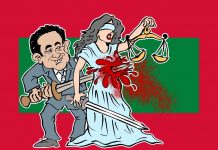
The jailing of Shahzan and Leevan is particularly shameful because it strikes at the heart of accountability. A free press exists precisely to hold the powerful to account, not to act as a propaganda wing for any government. When asking a question becomes “contempt,” and reporting becomes a punishable offence, democracy itself is placed behind bars.The Road AheadPresident Muizzu came to power promising a new chapter of sovereignty and good governance. Yet his administration increasingly resembles the very authoritarian tendencies previous generations of Maldivians struggled against. Using the judiciary and police to settle scores with critical media is not governance — it is intimidation.
We call on the Muizzu government to immediately release Mohamed Shahzan and Leevan Ali Nasir, return seized equipment to Adhadhu, lift all travel bans and gag orders, and allow transparent, fair proceedings.
More importantly, we urge the administration to recommit to the constitutional guarantees of freedom of expression and press freedom. To my fellow Maldivian journalists: this is a test of our resolve. The Maldives needs independent voices now more than ever. We must continue to report without fear or favour, even as the space for truth narrows. History will judge this era harshly not for the questions we asked, but for the silence some tried to impose. The fight for media freedom in the Maldives is the fight for our democracy itself. We cannot afford to lose it.