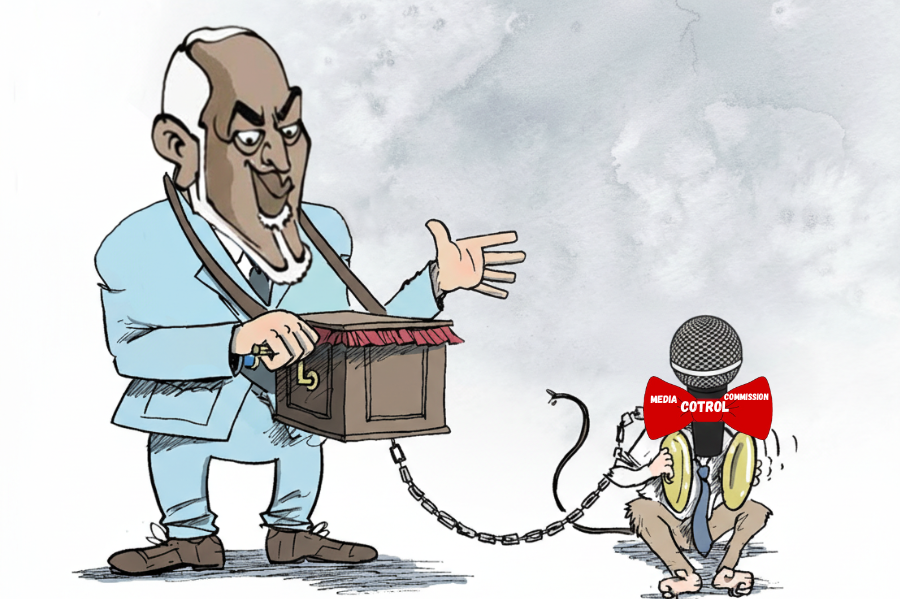
A satirical cartoon depicting President Mohamed Muizzu and his cronies allegedly engaging in corruption has ignited a heated debate not because of its artistic merit, but because of the government’s swift action to suppress it. The controversy has sparked widespread concern over press freedom suppression during the Muizzu tenure.
The Cartoon That Sparked the Controversy
The cartoon, published by media outlet Adhadhu, aimed to create public debate over Muizzu and his corrupt cronies, who are involved in corruption and routinely use religion as a tool to protect their undemocratic and corrupt practices branding anyone who opposes them as “Ladheenee.” It was intended as political satire, highlighting abuses of power rather than mocking religion itself.
Government Crackdown
Within hours of the cartoon’s release, the Maldives Media and Broadcasting Commission established in September 2025 under President Muizzu, issued a directive ordering Adhadhu to remove the cartoon from all social media platforms and suspend the Adhadhu Siyaasee cartoon segment until further notice. The Commission claimed the cartoon had hurt religious sentiments.
Critics argue that the Commission, widely seen as a tool to suppress media criticism, is using such orders to silence dissent and intimidate journalists and social media influencers who question government actions reflecting a broader pattern of media suppression during the Muizzu tenure.
On 25 January 2026, the Commission again issued an order through its official X account, stating that the cartoon was banned from being shared on social media platforms.
Adhadhu and Journalists Push Back
In response, Adhadhu sent a letter to the Commission stating that it would not comply, calling the directive politically motivated rather than legally justified.
The move drew sharp criticism from the Maldives Journalists Association (MJA) and other media professionals, who described it as a direct attack on press freedom and freedom of expression.
“Censoring satire is a slippery slope toward silencing all dissent and sets a dangerous precedent,” the association said in a statement, warning that the new Media Control Act is increasingly being weaponized against independent media during Muizzu’s tenure.
Legal Challenge Against the Media Control Law
Escalating its response, the Maldives Journalists Association has filed a case at the High Court seeking to quash the Media and Broadcasting Commission Act.
Speaking at a news conference on January 26, MJA President Ahmed Naif said the law was enacted in violation of the Constitution and international conventions.
“It is very clear that this law is in violation of the principles envisioned by the Constitution of the Maldives and the three-part test mentioned in Article 19 of the ICCPR,” Naif said.
The legal challenge marks a significant step by the journalism community to push back against what it sees as an unconstitutional attempt to institutionalize media suppression.
Social Media Outcry
The controversy quickly spilled over onto social media, where journalists, influencers, and opposition leaders shared the cartoon in protest. Public discussion questioned whether the Commission’s order genuinely reflected a violation of the law or whether it was a politically motivated attempt to suppress media criticism further highlighting the climate of media suppression during the Muizzu tenure.
Many users expressed frustration, asking why the Muizzu government appears so fearful of criticism, especially satire, which has long been a legitimate form of political expression in democratic societies.
Implications for Press Freedom
The cartoon controversy highlights a troubling trend: the use of legal frameworks and state-controlled institutions to curb dissent and control the narrative. Critics warn that if satire and criticism are suppressed today, investigative journalism and accountability reporting could be next.
“The danger of the new Media Control law in action is real. Silencing independent media does not protect religion or society it only protects those in power from accountability.”
As the debate continues, the international community and media freedom watchdogs are closely monitoring how the government handles dissent. The outcome will serve as a critical indicator of whether democratic values can be preserved or whether media suppression during the Muizzu tenure will continue to overshadow press freedom.