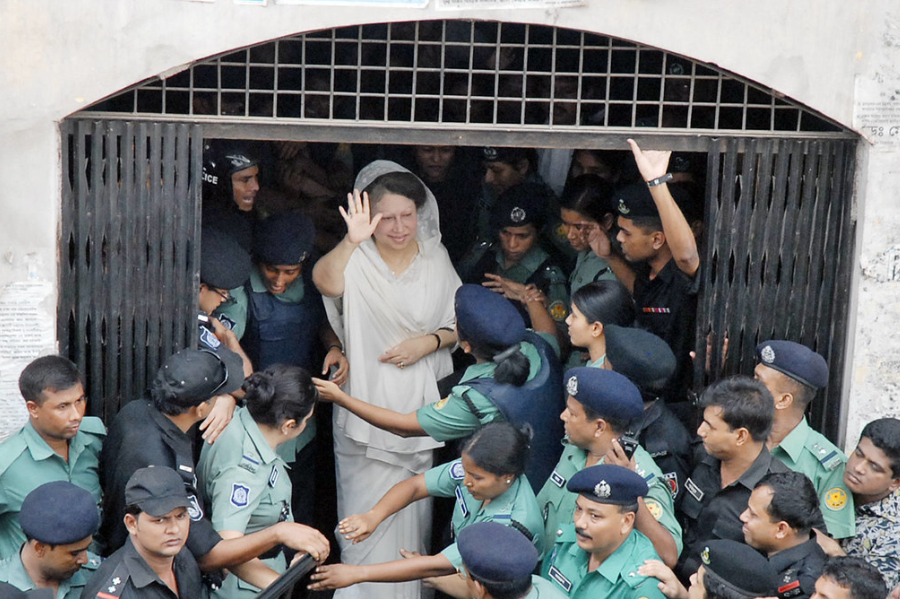
Bangladesh’s first female prime minister and one of the most influential figures in the country’s political history, Begum Khaleda Zia, passed away on Tuesday at the age of 80 following a prolonged illness, her party, the Bangladesh Nationalist Party (BNP), announced.
According to a BNP statement, Khaleda Zia died at Evercare Hospital in Dhaka around 6:00 a.m., shortly after the Fajr (dawn) prayer. She had been undergoing treatment since November 23, 2025, suffering from multiple serious health conditions, including advanced liver cirrhosis, heart and lung complications, diabetes, arthritis, and kidney problems. Her condition had deteriorated sharply in recent weeks, and she was placed on life support shortly before her death.
Khaleda Zia was born on August 15, 1945, in Jalpaiguri, then part of undivided British India. Following the Partition of India in 1947, her family relocated to Dinajpur, now in northern Bangladesh, where she later became deeply rooted politically.
She entered politics after the assassination of her husband, President Ziaur Rahman, in 1981. Initially a reserved and reluctant figure, she rose to prominence as leader of the BNP, the party founded by her husband.
In 1991, Khaleda Zia became Bangladesh’s first woman prime minister, leading the BNP to victory in the country’s first fully democratic election after years of military rule. She served three terms in office: 1991–1996, a brief second term in 1996, and 2001–2006.
For decades, Bangladesh’s political landscape was dominated by her intense rivalry with Sheikh Hasina, leader of the Awami League. The two leaders — often dubbed the “Battling Begums” — alternated in power amid frequent protests, political boycotts, and mutual allegations of corruption.
In 2018, Khaleda Zia was jailed after being convicted in corruption cases, a move her supporters described as politically motivated. She remained imprisoned for over two years, during which her health deteriorated significantly.
In 2020, she was released from prison on conditional bail on humanitarian grounds and allowed to receive medical treatment, though restrictions on her political activities remained in place. Despite brief medical treatment abroad, including in London, her health continued to decline in the years that followed.
Khaleda Zia’s death marks the end of a defining era in Bangladesh’s turbulent democratic journey. She is survived by her son, Tarique Rahman, a senior BNP leader who recently returned from exile and remains active in national politics.
Her passing comes at a critical moment for Bangladesh, with the country navigating political uncertainty and elections expected in the near future. Tributes and condolences have poured in from across the political spectrum, reflecting her lasting impact on the nation’s history.