A series of developments between March 23 and March 24 has drawn attention to the Maldives, raising fresh questions about the Muizzu government’s foreign policy messaging, diplomatic coordination, and overall handling of sensitive international issues particularly at a time of heightened tensions involving Iran, the United States, and Israel.
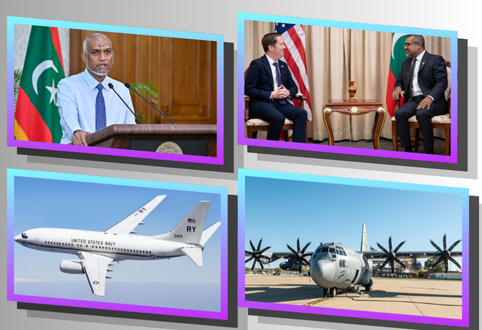
The situation began to unfold during a press conference at the President’s Office on Monday, where Mohamed Muizzu spoke about the ongoing conflict in the Middle East. Shortly after, a statement attributed to the President began circulating widely on social media, claiming that Iran should directly attack Israel and target U.S. and Israeli sites in the region. The remarks quickly gained traction, shared by prominent influencers and widely debated online. While some interpreted the comments as encouraging escalation, there has been no official clarification from the President’s Office regarding the context or accuracy of the statement, leaving both the public and observers uncertain about the government’s actual position.
At the same time, the Maldives was hosting a high-level visit from U.S. Special Envoy for South and Central Asia, Sergio Gor, who arrived in the country on Sunday. On Monday, he held meetings with Foreign Minister Abdulla Khaleel and Minister Ghassan Maumoon, where discussions reportedly focused on bilateral relations and areas of mutual interest. However, details of these discussions were not made public. Adding to the uncertainty, a scheduled meeting between the U.S. envoy and President Muizzu was unexpectedly cancelled, with no official explanation provided. The timing of this cancellation, coming amid the circulation of the President’s alleged remarks, has raised further questions.
As these developments unfolded, another issue added to the growing sense of confusion—conflicting statements from senior government officials regarding the use of Maldivian airspace. On March 12 , Minister Khaleel stated that certain countries had requested permission to use Maldivian airspace. Yet, just a week later, President Muizzu said he was unaware of any such requests and emphasized that he would not allow the Maldives to be used in any war. The contradiction between these statements has led to concerns about coordination at the highest levels of government, particularly on matters related to national security and foreign policy.
Meanwhile, reports of U.S. military aircraft movements in the region have added another layer to the situation. On Tuesday, March 24, tracking reports indicated that two U.S. military aircraft a C-17 Globemaster III and a C-40 Clipper passed through the Maldivian Flight Information Region while en route to Diego Garcia. This follows an earlier incident in late February, when a U.S. Air Force C-130 Hercules landed at Velana International Airport after arriving from Seychelles. While such movements are not unusual, their timing—coinciding with diplomatic engagements and political statements—has drawn increased public attention.
Taken together, these developments over a short 48-hour period have created more questions than answers. A widely circulated controversial statement, a high-level diplomatic visit, a cancelled presidential meeting, conflicting official statements, and reports of military activity have all contributed to a growing sense of uncertainty. As of now, there has been no clear explanation addressing these issues, leaving many to wonder whether this reflects a shift in foreign policy or simply a breakdown in communication within the government.